
Now Reading: The Story Behind the Women on Hunger Strike in Caracas Demanding Release of Political Prisoners Amid Amnesty Law Stalemate
- 01
The Story Behind the Women on Hunger Strike in Caracas Demanding Release of Political Prisoners Amid Amnesty Law Stalemate
The Story Behind the Women on Hunger Strike in Caracas Demanding Release of Political Prisoners Amid Amnesty Law Stalemate

Amid Physical Decline and Lack of Medical Aid, the Protest Pushes for Fulfillment of Release Promises
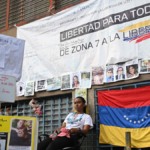
Nine women are continuing a hunger strike outside the National Bolivarian Police (PNB) command in Caracas. Photo: AFP
By Ana María Rodríguez Brazón, EL TIEMPO Correspondent in Caracas. February 18, 2026, 02:30 Updated: February 18, 2026, 02:30
Nine women are persisting with a hunger strike in front of the National Bolivarian Police (PNB) command, Zone 7, in Caracas, weakened after more than 72 hours without consuming food and displaying clear signs of physical decline.
The demonstration, which started on Saturday as a desperate measure to call for the release of political prisoners, has already experienced its first major incident: one of the original ten participants was taken to a hospital on Monday after experiencing a severe health breakdown, according to activists supporting the protest.
Also Read: NGO States That More Than 600 Political Prisoners Remain in Venezuela After Releases – Agencia EFE
A large banner reading “Freedom for All” is displayed outside the police command. Prisoners are still held there, with their relatives camping nearby since mid-January.
There has not been adequate medical care, yet the women vow to keep going until the commitment from Assembly President Jorge Rodríguez is met. On January 8, he stated that “a large number” of individuals detained for political reasons would be freed.
The woman who suffered the health issue was transported to a medical facility by taxi, as no ambulances were available, even though the right to protest is guaranteed in Venezuela.
Family members on hunger strike. Photo: AFP
“The indifference and absence of responses from the State keep placing the lives and well-being of these relatives and the political prisoners—who are also on hunger strike—at serious risk,” posted the Committee for the Freedom of Political Prisoners on X.
The committee further reported that police officers guarding the site blocked the administration of IV fluids to the protesting women.
According to the organization Foro Penal, at least 600 political prisoners are still in the country. So far, only 444 releases have been verified.
Also Read: Nicolás Maduro’s Second Hearing Before U.S. Justice Delayed: Now Set for March 26 – Santiago Venera Salazar
Figures differ among various organizations because some cases were never documented out of fear of publicity. “We are witnessing a surge in new reports, cases that no one knew about,” Óscar Murillo, coordinator of the NGO Provea, told EL TIEMPO.
Murillo emphasized that the fear of retaliation was so intense that, before January 3, many chose to remain silent and not reveal that their relatives were imprisoned.
Hunger Strike Under Intense Sun
The relatives on hunger strike are staying under umbrellas and on mats. The heat is intense, but they try to stay composed and avoid talking to conserve strength. Behind them, police have formed a barrier to prevent any approach to the prison entrance.
One of the strikers is Sandra Rosales, wife of chief officer Dionis Quintero, who was arrested on November 19, 2025. She arrived at Zone 7 on January 17 and has remained there since.
She is joined by Jessy Orozco, daughter of former deputy Fernando Orozco. Since his arrest at the end of last year, there has been no contact with his family.
Also Read: Delcy Rodríguez Initiates Dismantling of Social Programs Network Created by Chávez and Maduro: How the Chavismo Restructuring Is Progressing – Ana Rodríguez Brazón
According to chavismo, 17 releases occurred in Zone 7 on Saturday, but none have followed since then.
This hunger strike is taking place during the discussion of an amnesty law project, which was approved in its first reading by the Venezuelan Parliament. The debate is scheduled to resume on Thursday, potentially leading to its approval.
Various human rights organizations have voiced concerns that, although it represents an important step, the law excludes notable cases, meaning a significant number of political prisoners would remain incarcerated.
Ana María Rodríguez Brazón – EL TIEMPO Correspondent – Caracas
Follow all International news on Facebook and Twitter, or in our weekly newsletter.